
Painting and treating your home for pests are two major home renovation projects that should be done with utmost care.
While both of them are equally important, the question is whether you should be performing pest control before or after painting your home.
While both of them are equally important, the question is whether you should be performing pest control before or after painting your home.
Well, the answer is straightforward because in most cases, you should complete all your cleaning, painting, polishing, and carpeting jobs before treating the areas for pests.
Also, if you are planning to move into a new property, it’s best to have all the pest control processes completed after you have painted the property and before you move in.
But that’s not always true, as there can be pros and cons of both, i.e., when you are painting before pest control and when painting after pest control.
Paint Before Pest Control
Painting, staining, or polishing your wood floors (walls and ceilings) before pest control is beneficial because when these surfaces are exposed, they can absorb the insecticides like termiticide much better.
This also means that once you have painted the wood and walls, you can then proceed with spraying insecticides and fumigation.
This will not eliminate the effects of chemicals sprayed during the painting process.
Since insects like wasps, bedbugs, etc., can not withstand the smell of paint and sprays, they will most likely move themselves to some other safer place when they come in contact with the treated areas.
For better results, you can use specialized bug-repellant paints and paint additives for repelling termites, bed bugs, and other insects.
These paint additives come with a repulsive odor that helps in keeping the pests away from your property.
Painting House After Pest Control
Many people prefer repairing, cleaning, and painting the interiors and exteriors of their homes after they have treated them for pests.
Pest control experts recommend using this strategy, especially when you are fumigating the wood floors, furniture, and other surfaces for termites.
They also recommend installing your engineered wood floors, vinyl floors, or rain gutters after pest control, as most of these installations use adhesive products that need enough curing time.
The reason is – termite fumigants tend to draw moisture out of the surfaces because these are usually applied or introduced at cold temperatures.
While freshly applied paint may feel dry to the touch, most of them require at least five days to cure and get dried completely.
Most vanish, stains or adhesives will also need proper time to set in properly.
If termite fumigation is done after painting, the moisture will be drawn away too quickly, which can then leave watermarks on the freshly painted surfaces.
Proper adhesion may also be compromised, which can lead to the peeling of paint quickly.
It’s, therefore, good NOT to schedule termite fumigation for at least five to seven days after you have painted, varnished, or stained the surfaces.
| Feature | Painting BEFORE Pest Control | Painting AFTER Pest Control |
| Primary Goal | Enhanced chemical absorption and barrier creation. | Protecting the finish and ensuring material integrity. |
| Technical Edge | Raw, unsealed surfaces (wood/drywall) act like a sponge for termiticides. | Prevents “flash-drying” of paint/adhesives caused by fumigant-induced moisture loss. |
| Mechanism | Insecticides are applied over the “base,” then sealed or supplemented with additives. | Eradicates the colony first so you aren’t literally “painting over” a structural problem. |
| The “Odor” Factor | Synergistic effect; the combined VOCs and repellent additives drive pests to find a new zip code. | Allows paint/stain odors to dissipate without being trapped under or altered by heavy chemicals. |
| Risk Factor | Painting over an active infestation can lead to “breakouts” where pests eat through the new film. | Fumigating too soon after painting (within 5 days) causes peeling, watermarks, and adhesion failure. |
| Best For | Preventive maintenance and applying “Active” insecticidal paint additives. | Heavy infestations (Termites/Bed Bugs) and floor refinishing (Vinyl/Hardwood). |
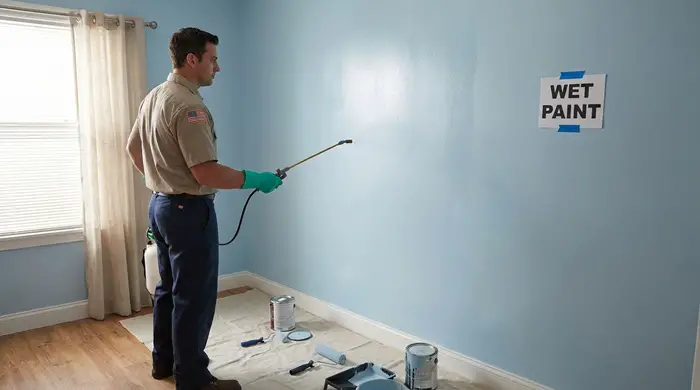
Spraying Pest Control on Wet Walls
It is generally a bad idea to spray liquid pest control directly onto freshly painted walls. Even if the paint feels dry to the touch, it often takes several days or even weeks to fully “cure.”
During this period, the paint film is still hardening and evaporating solvents.
Introducing moisture or chemicals can lead to paint damage from pest control, such as staining, bubbling, or unsightly discoloration, where the chemicals react with the uncured pigments.
Timing and protection
For the best results, you should wait after the paint dries to do fumigation or liquid spraying—ideally at least 24 to 48 hours for standard latex paint and up to a week for oil-based finishes.
If you are dealing with more intensive structural treatments, the order of operations matters.
For example, people often ask how long after termite treatment can you paint; usually, you can paint as soon as the termiticide has dried (about 24 hours), provided the walls weren’t structurally compromised.
Conversely, painting after fumigation is generally safe once the home has been cleared for re-entry, as the gas does not leave a residue that interferes with paint adhesion.
Insects that threaten fresh paint
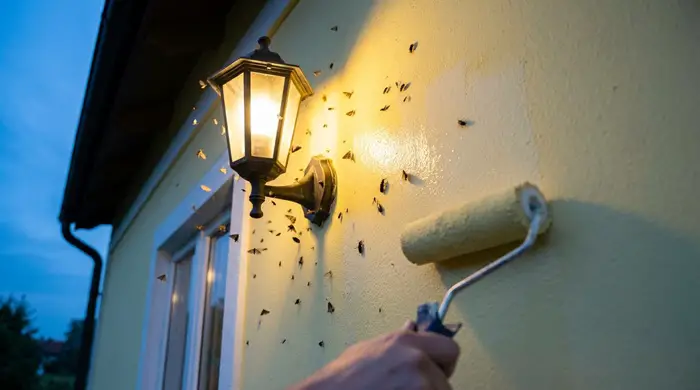
While the spray itself is a risk, certain insects are attracted to the scent of wet paint (specifically the VOCs and moisture) and can ruin the finish:
Fungus Gnats & Midges: These tiny flyers are attracted to the moisture and get stuck in the “tack,” leaving permanent leg marks and bodies embedded in the wall.
Plaster Beetles: Attracted to the dampness and potential mold growth in new construction or freshly plastered/painted areas, they can scuttle across wet surfaces and mar the texture.
Ants: Some species are drawn to the chemical smells of certain paints; their trails can create physical streaks in a wet coat.
To protect your investment, keep windows closed during the drying phase and ensure the room is well-ventilated but insect-free.

Does Paint Kill House Bugs and Pests?
While standard paint doesn’t technically kill bugs, it serves as a powerful first line of defense by transforming your walls into a seamless fortress.
By sealing the tiny fissures and porous gaps where pests typically nest or enter a home, high-quality paint essentially “evicts” them from their hiding spots.
To turn your walls into an active deterrent, you can utilize insecticide paint additives or specialized repellent coatings.
These are engineered to kill common invaders like ants, spiders, and cockroaches on contact, often maintaining their potency for several years.
Alternatively, you can put insecticides in paint, provided the formula is EPA-registered.
The Environmental Protection Agency has registered several insecticides that can be added to paint to kill many insects. These are completely safe for humans and pets and can be used for both interior and exterior purposes, like painting furniture, stables, barns, exterior walls, etc.
To add insecticide to your paint, you can follow these steps…
- Wear protective clothing, eye protection, and a face mask
- Pour your oil-based or latex paint into a clean 5-gallon bucket
- Add insecticide to your paint (1 to 2 ounces of insecticide per gallon of paint)
- Mix them thoroughly with a paint stirrer or a wooden stick and apply them using a brush, roller, or sprayer
While applying paint to the surface, make sure you stir it occasionally to avoid the pigments and insecticides from settling at the bottom of the bucket.
Also, if you have to use large quantities of paint, mix smaller quantities, particularly the amount that you will use within two to three hours. Insecticides, when mixed in the paint, will tend to lose their effectiveness if left unused for long periods.
For the most effective results, focus your efforts on “high-traffic” insect zones—think dark, damp areas like under kitchen sinks, bathroom nooks, and the hidden walls behind heavy wardrobes.
However, keep in mind that paint is a preventative measure, not a cure for an active crisis.
If you’re already dealing with a full-blown infestation, you should always bring in professional pest control to clear the area before you pick up the brush; otherwise, you’re simply painting over a problem that will eventually crawl back out.
What Paint Colors Repel and Attract the Pests?
Choosing a paint palette is usually an emotional exercise in “vibes,” but if you aren’t careful, you might accidentally be rolling out a neon “Open for Business” sign for the local insect population.
While your walls won’t exactly leap off the studs to devour a termite (unless you’re using specialized insecticidal coatings containing permethrin or deltamethrin), the spectral reflectance of your siding matters immensely.
Most pests aren’t critiquing your aesthetic; they are navigating via phototaxis—the innate tendency to move toward or away from a light source.
Because many insects possess compound eyes sensitive to Ultraviolet (UV) and blue-green spectra, your house isn’t just a color; it’s a thermal and visual beacon.
Here is the technical breakdown of how your home’s “outfit” influences the local ecosystem:
The Repellent Paint Colors for Pests
Haint Blue: A classic Southern staple with a technical edge. Historically, “Haint Blue” on porch ceilings was thought to mimic the sky, tricking wasps and spiders into not nesting there.
While the “sky” theory is a bit of architectural folklore, many light blues have low UV-reflectance, making them effectively “invisible” or uninteresting to phototactic pests.
White: For interiors, white is the “clean room” standard. It offers high visibility for humans to spot intruders and generally lacks the UV signatures that signal “food” or “mate” to an insect.
On the exterior, however, its high Light Reflectance Value (LRV) can actually deter birds by being too bright, though it may occasionally attract certain flies that seek heat.
Yellow: The ultimate paradox. Yellow is notoriously disliked by mosquitoes and houseflies—which is why “bug lights” are tinted that way.
However, it is a high-frequency invitation for pollinators like bees and hoverflies who associate it with pollen-rich blossoms. Use with caution if you’re allergic to stings.
The “Magnet” Palette: Paint Colors to Avoid
Deep Browns & Blacks: If you want to be a mosquito’s favorite neighbor, go dark.
These colors absorb heat (creating a thermal signature) and provide the high-contrast silhouette that mosquitoes use to track “blood meals” (that’s you). They associate these dark, heat-absorbing masses with mammalian hosts.
Floral Mimicry (Oranges & Pinks): Painting your exterior “Sunset Coral” is essentially catfishing the local insect population.
These shades sit right in the sweet spot for pollinators looking for nectar. Unless you want your siding to be a literal “bug’s life” documentary, keep the floral tones for the garden, not the gutters.
Green: While green is technically a “neutral” for many pests who see it as foliage (camouflage), it won’t actively repel anything.
It’s the “inconspicuous” choice—you won’t attract a swarm, but you won’t scare anyone away either.
The Conclusion
While it’s good to clean and paint your home before calling pest control professionals, there are instances when painting after fumigation can be beneficial.
Also, because paint color does influence pests, knowing which ones to use in the home can help reduce their population or keep them from entering.
Basically, you’ll want to use the right colors designed to repel pests or at least not attract them to your home. Plus, you can also use paint colors that help highlight the presence of pests so you can spot and eliminate them faster.
Share the post "Should I Paint My Home Before or After Pest Control?"

Many times people ask me whether they can do pest control in the winter. Also, if it is really important, Read more
If you think pest control is just about spraying chemicals and calling it a day, think again. Modern pest control Read more
When it comes to controlling the pests in your garden or in a field, there are two options you can Read more

Finding an uninvited guest in your home is usually a drag, but it’s a whole different level of "unpleasant" when Read more

Welcome to ProShieldPest.com. I am Tina Jones. I have been working as a pest removal professional in Winslow, Arizona lately. At present, I love to spend my time with my family as a retiree.
Here I share all my knowledge and experiences to help people understand better how they can stop pests at their homes without actually killing them. Hopefully, the information you will find here will help in safeguarding your home! You can check more about me here.