
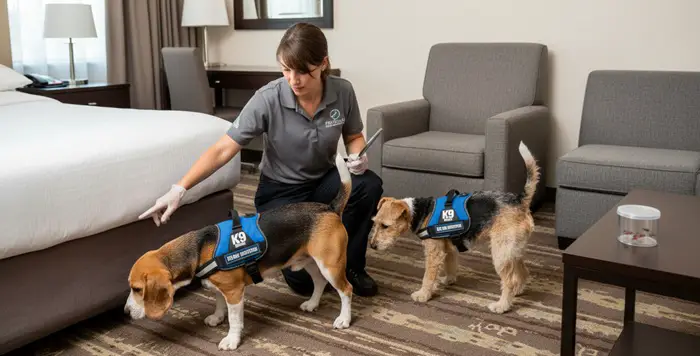
If you’ve ever spent an afternoon dismantling a mahogany bed frame with a flashlight and a prayer, only to find nothing—despite the itchy red welts on your ankles—you know that bed bugs are the ultimate hide-and-seek champions.
They don’t just hide; they vanish into the microscopic voids of your life.
Enter the four-legged solution.
While human technicians are limited by the visible spectrum and the reach of a screwdriver, a trained K9 bed bug detection dog lives in a world of “scent pictures.”
To a dog, your bedroom isn’t a collection of furniture; it’s a topographical map of odors.
In the high-stakes world of US property management and residential pest control, K9 scent detection has moved from a “cool party trick” to a mandatory diagnostic tool.
It’s faster, more accurate, and—let’s be honest—way more charismatic than a guy with a magnifying glass.
Understanding K9
In the world of pest control, K9 simply stands for “canine” (a play on the word canine).
The most common breeds used for K9 duties are German Shepherds, Belgian Malinois, and Labrador Retrievers, chosen for their intelligence, scent ability, and work drive — similar to how pest control companies choose specific tools or specialists for specific infestation problems.
Just like different pest control technicians specialize in termites, rodents, or bed bugs, different dog breeds are selected based on the specific detection or control task required.
While we usually associate sniffer dogs with search-and-rescue or narcotics, they have become the “high-tech” biological sensors of the pest industry.
The primary reason is superior biology. A bed bug dog is trained to detect the specific pheromones and volatile organic compounds (VOCs) emitted by live bed bugs and their viable eggs.
While a human technician is limited by what they can see with a flashlight—often missing bugs hidden behind baseboards or inside electrical outlets—a dog can “smell” through walls and furniture.
How K9 Bed Bug Detection Works?
In the world of professional pest control, we often say that a dog’s nose is the most sophisticated piece of technology on the planet.
While humans rely on sight, a bed bug scent detection dog lives in a world of “odor pictures.”
A dog’s snout contains up to 300 million olfactory receptors—compared to a measly 5 million in humans—and the part of their brain dedicated to analyzing smells is 40 times larger than ours.
This biological “hardware” allows dogs to utilize what scientists call active sniffing.
Unlike a human who takes one long breath, a dog inhales and exhales up to 300 times per minute, creating a continuous loop of air that captures microscopic volatile organic compounds (VOCs) emitted by live pests.
In technical terms, a certified K9 can detect scents in concentrations as low as parts per trillion. To put that in perspective, a dog could smell a single teaspoon of sugar dissolved into two Olympic-sized swimming pools.
For the pest niche, this means the dog isn’t looking for the bug; they are looking for the smell of the bug.
They can identify the specific pheromones of live bed bugs and viable eggs while ignoring “distractor” scents like dead bugs, cast skins, or fecal spotting.
This allows them to pinpoint a single “hitchhiker” bug hiding deep inside an electrical outlet or behind a wooden baseboard without the technician ever having to move a single piece of furniture.
The Pros and Cons of Hiring a Bed Bug Dog
Deciding whether to pay for a K9 bed bug inspection usually comes down to a balance of speed, cost, and psychological peace of mind.
Like any high-end service, there are distinct advantages and a few “tail-wagging” caveats you should know before booking.
The Pros:
Unmatched Accuracy: In controlled studies, such as those conducted by the University of Florida, certified dogs hit accuracy rates of 95% to 98%.
Humans? We usually hover around 30% to 50% for early-stage infestations.
Targeted Treatment (Cost Savings): This is the biggest ROI. If a dog only alerts on a specific armchair, you can treat just that area rather than spending $2,000 on a whole-house heat treatment.
Non-Invasive: You don’t have to dismantle your bed frame or empty your closets for a dog to do its job. They “clear” a room simply by walking through the “scent cone.”
The Cons:
Higher Upfront Cost: A professional K9 team (handler + dog) usually costs between $200 and $500 per visit, which is higher than a standard visual check.
Environmental Sensitivity: Dogs are biological, not mechanical. High heat, heavy perfumes, or strong cleaning chemicals (like bleach) can mask the scent of bed bugs, potentially leading to a “false negative.”
Prep Work Required: For the best results, you must turn off fans and AC 30 minutes prior to the visit to allow the “scent” to settle into a detectable cloud.
K9 Bed Bug Inspections vs. Visual Inspections
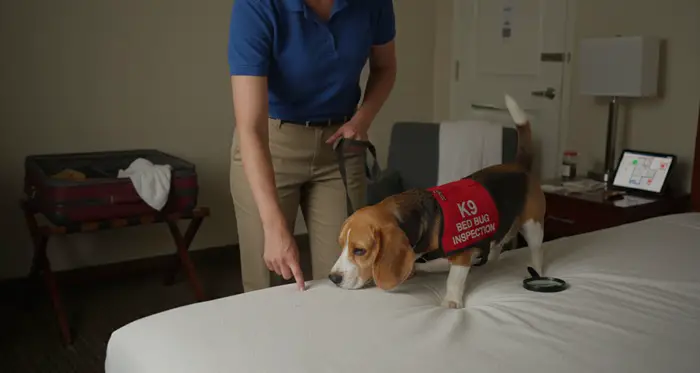
When you’re dealing with a bed bug infestation, the “Human vs. Dog” debate is one of the most common topics in the pest niche.
To be blunt: the human eye is a terrible tool for finding a bug the size of an apple seed that hates light and loves 1-millimeter cracks.
| Feature | Human Visual Inspection | K9 Scent Detection |
| Primary Tool | Flashlight & Magnifying Glass | 300 Million Scent Receptors |
| Accuracy (Early Stage) | 17% – 30% | 90% – 98% |
| Invasiveness | High (Moving furniture/carpet) | Minimal (Walk-through) |
| Speed | 45-60 mins per room | 2-5 mins per room |
| Evidence Required | Must see a bug/egg | Scent of live bugs/eggs |
The main technical difference is accessibility.
A human technician can only find what they can see. If a bed bug is tucked behind a heavy headboard bolted to a hotel wall, a human will miss it every time.
A K9 scent detection dog, like one trained by Orkin, however, doesn’t need to see the bug. They simply catch the “scent trail” leaking out from behind the headboard.
However, the best professional companies use a “Team Approach”: the dog finds the spot, and the human then uses a probe to find the physical evidence to confirm the “hit.”
How Much Does a K9 Bed Bug Inspection Cost?
A K9 bed bug inspection in the U.S. typically costs $300 to $600 for an average single-family home.
Smaller apartments may start around $250–$350, while larger homes, multi-unit buildings, hotels, or commercial spaces can range from $700 to $1,500+.
Compared to a standard visual inspection, K9 inspections cost more upfront, but they are faster, more precise, and can detect early infestations that the human eye might miss.
Most pest control companies use trained scent detection dogs—commonly breeds like the Labrador Retriever or Beagle—because of their strong odor detection abilities.
The final price depends on several key factors:
- Property Size: Larger homes or buildings require more time to inspect.
- Number of Units or Rooms: Apartments, condos, and hotels are priced per unit or per room.
- Location: Urban areas and high-cost-of-living states often charge more.
- Inspection Purpose: Real estate transactions, legal documentation, or clearance certificates may increase fees.
- Follow-Up Visits: Additional inspections or written reports can add to the total cost.
- Travel Fees: Some companies charge extra for properties outside their main service area.
While the cost may seem significant, early detection can prevent thousands of dollars in full-scale treatment.
Many companies also credit the inspection fee toward treatment if bed bugs are confirmed, making the investment more cost-effective in the long run.
NESDCA Certification: How to Hire a Professional K9 Team
In the US, you shouldn’t hire just any dog in a “Pest Control” vest. The gold standard for credibility is NESDCA (National Entomology Scent Detection Canine Association).
This is a third-party organization formed by pest control professionals to ensure that these dogs aren’t just well-behaved pets, but elite working professionals.
A NESDCA certified bed bug dog has passed a rigorous, double-blind test. This means neither the handler nor the dog knows where the “hides” (vials of live bugs) are located during the test.
To pass, the team must find every single live bug hide while ignoring “distractors” like food, dead bugs, or cricket droppings. If the dog alerts on a “fake” hide, they fail.
When hiring, always ask to see the current NESDCA certificate. These certifications are only valid for one year, requiring the team to re-test annually to prove their nose is still sharp.
Hiring a non-certified team is a gamble that could lead to “false positives,” resulting in you paying for expensive treatments you don’t actually need.
Post-Treatment Pest Inspection and Verification: The “K9 Clear” Certificate
One of the most valuable services in the pest niche is post-treatment verification.
After a professional heat or chemical treatment, the big question is: “Is it actually over?” Humans struggle with this because they might find old, dead bugs and mistake them for a failed treatment.
A bed bug detection dog is the perfect tool here because they are trained to alert only on live bugs and viable eggs.
About 10 to 14 days after your final treatment, a K9 team can sweep the house. If the dog remains “quiet” (no alerts), the company will issue a “K9 Clear” Certificate or a clearance letter.
For US landlords and hotel owners, this certificate is a critical legal document.
It provides a “paper trail” proving that the property was pest-free at a specific point in time, which can be a lifesaver in tenant disputes or “slumlord” litigation.
It’s the ultimate “all-clear” that lets you finally sleep through the night without wondering if every itch is a survivor.
Conclusion: Is the K9 Worth the Investment?
When it comes to bed bugs, the “cheapest” option—a quick visual glance—is often the most expensive mistake. While a K9 bed bug inspection costs more upfront (typically $200–$600 in the US), the long-term ROI is undeniable.
By pinpointing infestations with 98% accuracy, a certified dog allows for targeted treatments.
Instead of paying thousands to heat-treat an entire house, you can isolate the problem to a single room or piece of furniture, saving you money and reducing chemical exposure.
Whether you’re a homeowner catching a “hitchhiker” early or a landlord needing a “K9 Clear” certificate for legal peace of mind, hiring a NESDCA-certified team is the smartest move you can make.
In the high-stakes world of pest control, a professional nose isn’t just a luxury—it’s the gold standard for a bug-free life.
Share the post "K9 Bed Bug Detection: Are Sniffer Dogs Worth It?"


Many times people ask me whether they can do pest control in the winter. Also, if it is really important, Read more

If you think pest control is just about spraying chemicals and calling it a day, think again. Modern pest control Read more

When it comes to controlling the pests in your garden or in a field, there are two options you can Read more

Finding an uninvited guest in your home is usually a drag, but it’s a whole different level of "unpleasant" when Read more

Welcome to ProShieldPest.com. I am Tina Jones. I have been working as a pest removal professional in Winslow, Arizona lately. At present, I love to spend my time with my family as a retiree.
Here I share all my knowledge and experiences to help people understand better how they can stop pests at their homes without actually killing them. Hopefully, the information you will find here will help in safeguarding your home! You can check more about me here.